‘Noir-ish’ Jeanne in ‘The Letter’

Tags

, , ,

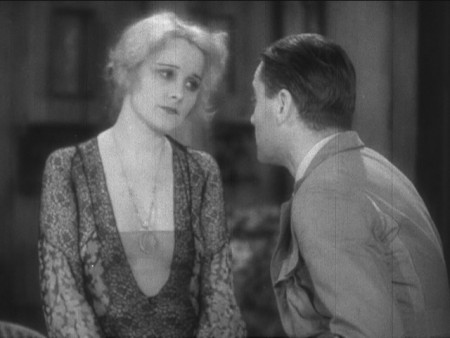
The Letter 01 - Jeanne Eagels Herbert Marshall

Jeanne Eagels confronts her lover, played by Herbert Marshall, in ‘The Letter’ (1929)

A viewing of Bette Davis’ The Letter remake led one blogger back to Jeanne Eagels’ original performance as the murderess Leslie Crosbie, over at Classic Hollywood:

I re-watched it to see if there was anything noirish about it and wasn’t disappointed. Jeanne’s performance is powerful, the French director Jean De Limur also had scenes that wouldn’t disappoint noir fans. Jeanne Eagels descending the stairs to meet with her murdered lover’s Chinese mistress is pure noir cinematography. I must say this version is my favorite version of W. Somerset Maugham’s The Letter.

Although a work-print has been available for some time, a fully restored version of The Letter (1929) was released on DVD in 2011.

First Review: Five Stars for Jeanne

Tags

, , , ,

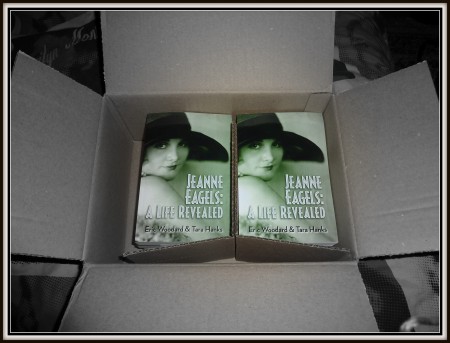
P1060266fbwmmThe weeks following publication are an anxious time for any author, as we nervously, and somewhat impatiently await feedback from our readers. Now, Jeanne Eagels: A Life Revealed has its first customer review on Amazon.com – from fellow author Steffan B. Aletti, and happily, it’s a rave!
Thank God Eric Woodard has seen fit to resurrect Jeanne Eagels, one of the most beautiful and fascinating of the great stage stars of the early 20th Century … For those of us who had to rely pretty much on Kim Novak’s almost entirely fictional 1957 ‘biopic’, this book is revelatory, restoring her to her rightful place as a major actress respected throughout the English-speaking world and, most famously, the creator of Sadie Thompson … This book will finally put those outrageous fictions to rest …  Well worth reading if you want to learn about Broadway and Hollywood during the first couple of decades of the 20th century.

So if you’ve read and enjoyed Jeanne Eagels: A Life Revealed, please consider writing a short review for Amazon, Goodreads or your personal blog. (And finally, I would like to quote my ever-gallant writing partner, Eric: ‘I didn’t resurrect her alone …’)

The James Abbe Archive

Tags

, , , ,

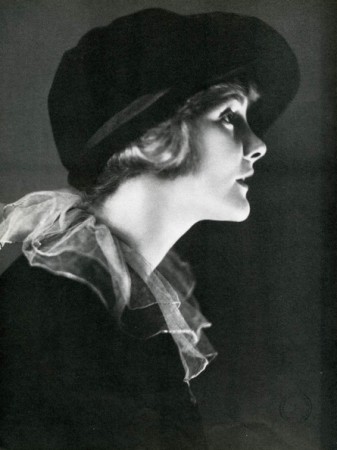
20130312150449-fd755485-me

This portrait of Jeanne Eagels, taken by James Abbe in 1919, was chosen for the cover of the Saturday Evening Post. Kendra Bean (author of Vivien Leigh: An Intimate Portrait) talks about her work at the Abbe Archive – and shares some restored photos – in a new blog post, ‘James Abbe: Capturing the Silent Screen.’

Abbe is also featured in David S. Shields’ recent book, Still: American Silent Motion Photography. On his Broadway Photographs website, Shields introduces an autobiographical essay by Abbe, first published in the Oakland Tribune from 1961-62.

Down in Philadelphia the Saturday Evening Post and Ladies Home Journal got wind of my success and perhaps remembering the brief contact I had with them that day I stopped en route to New York, asked me to submit some of my photographs to them. I did.

One of those I submitted was of actress Jeanne Eagels, and became a Post cover. For that picture I received $75. It was the first time the Post had used a photograph on its cover.

Months afterward, a poet called upon me in my New York studio with some of the prints I had sold the Post and the Journal. He had been assigned to write verses around them I had never heard of him previously, but got to know him later. His name was Christopher Morley.


Thanhouser and the Birth of Cinema

Tags

, , , , , , , , , ,

thanhouser doc

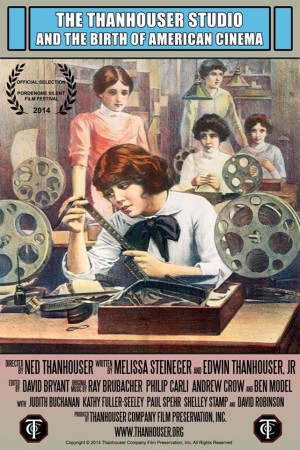
A 52-minute documentary, The Thanhouser Studio and the Birth of American Cinema, will be screened in the US on TCM tonight, July 5, at 9 PM (Pacific Daylight Time), followed by three classic Thanhouser movies, made from 1912-13, when the studio was at its peak (their prodigious output accounting for an estimated 25% of independent films released in America.)

From 1916-17, a young Jeanne Eagels starred in three films produced at the Thanhouser lot: The World and the Woman, The Fires of Youth and Under False Colors. The first two are still in print, and can be viewed here. By 1918, however, the studio would close its doors.

‘They brought the dramatic qualities of theater to the screen as they all found their way into moviemaking, they lavished attention on elaborate film sets in their roomy studio, and they took their cameras on location,’ writes critic Sean Axmaker (who has also championed Jeanne’s later work.) ‘The resulting films were vibrant and lively, with often complex stories, dynamic staging, and creative camera angles and lighting. The Thanhouser brand was a recognized mark of quality to audiences and distributors alike and a century later, the Thanhouser brand still stands for high production values, sensitive direction, intelligent stories, and fluid, energetic storytelling.’

For those unable to catch the documentary on TCM, it is also available to view at Vimeo On-Demand, while DVDs can be purchased from Amazon or the Thanhouser website.