Tags
Alfred Eisenstaedt, Andre De Dienes, Andrew O'Hagan, Andy Warhol, Arthur Felling ('Weegee'), Arthur Miller, Audrey Flack, Bruno Bernard, Cecil Beaton, Danny Lyon, Elliott Erwitt, Eve Arnold, Frank Powolny, George Barris, Joseph Jasgur, Jumpology, Laszlo Willinger, Leo Caloia, Life Magazine, London, Mao Zedong, Marilyn Monroe, Marilyn Monroe: A Portrait, Matty Zimmerman, Milton Greene, National Portrait Gallery, Norma Jeane, Pauline Boty, Philippe Halsman, Photomontage, Photorealism, Playboy, Pop Art, Robert Indiana, Rosie Broadley, Sam Shaw, The Seven Year Itch, Tom Kelley
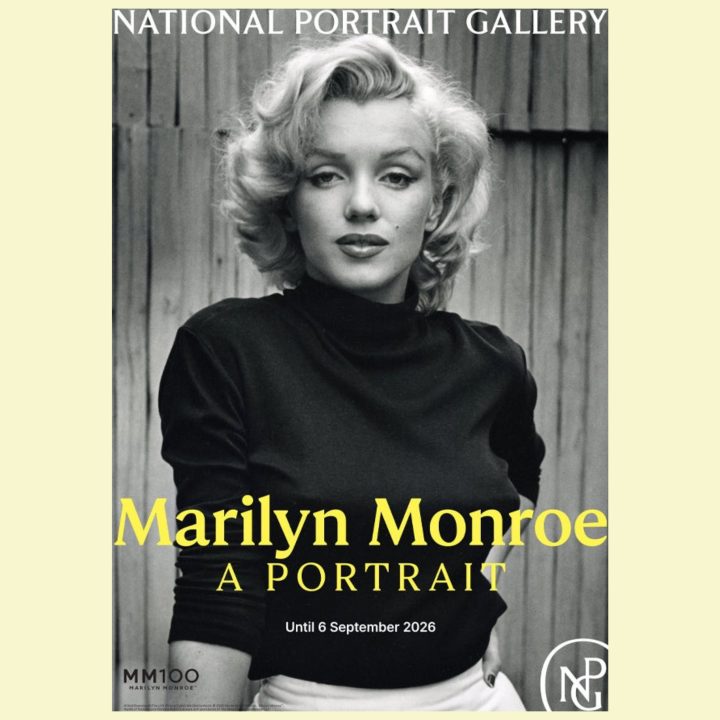
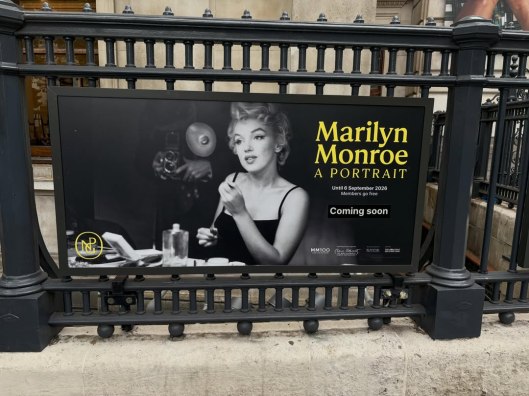
On a sunny London evening, a small crowd has gathered outside the National Portrait Gallery. It’s June 1st, 2026, and Marilyn Monroe was born 100 years ago today. Among the onlookers, a drag artist wears a replica of Monroe’s red gown with a diagonal strap from How to Marry a Millionaire. The doors open, and Marilyn herself greets us from within a black-and-white photograph overlaid with the words Marilyn Monroe: A Portrait in yellow type. This image was captured in early 1953 by Alfred Eisenstaedt, one of many European emigrés who came to define photojournalism in postwar America.
At the time of the shoot, Marilyn was twenty-six years old and about to take her place among Hollywood’s elite with the release of Gentlemen Prefer Blondes. She posed in the back yard of her Beverly Hills condo, wearing a black polo-neck jumper with white capri pants. One hand is placed on her hips, while the other reaches forward as she faces the camera with calm determination.
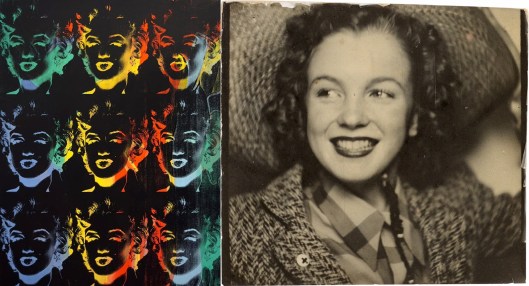
Inside, a large acrylic screenprint by Andy Warhol – the artist most indelibly associated with Marilyn’s posthumous legacy – retraces the contours of her face in neon negative. ‘Nine Multicoloured Marilyns’ comes from a Reversal Series undertaken by Warhol two decades after his original Marilyn Diptych of 1962. Opposite, a tiny sepia photo-booth shot shows a teenage Norma Jeane in a plaid shirt and tweedy jacket, with dark curls tucked into a tilted straw hat. In this 1940s ‘selfie’ she resembles Shirley Temple, another star whose picture Warhol collected.
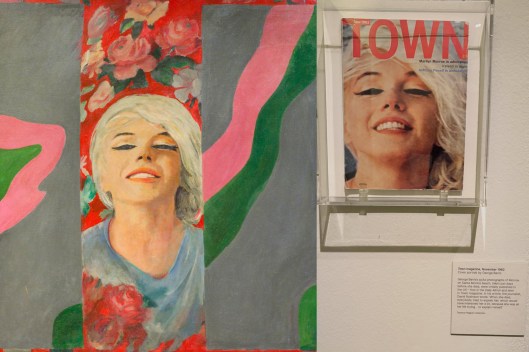
Like Warhol’s Marilyn Diptych, ‘Colour Her Gone’ was painted in the weeks after Marilyn died. Pauline Boty took her inspiration from a close-up photograph by George Barris, which made the cover of the British magazine Town in the autumn of 1962. In the painting, named after a pop song of the period, Boty sets Marilyn’s face among red roses between funereal blocks of grey. Little-known at the time, Boty would also die young and become a cult figure after decades of critical neglect. What the painting lacks in Warholian finesse is boosted by Boty’s tenderness.
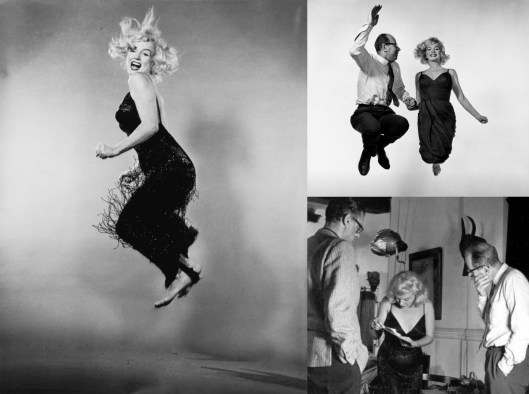
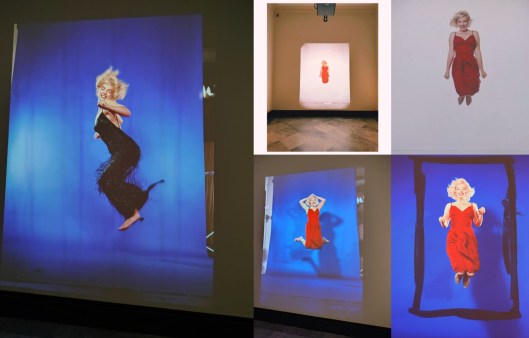
If these pieces serve as a prelude, the exhibition begins in earnest with a room devoted to Philippe Halsman, the Latvian-born photographer who worked with Marilyn at several key stages of her career. A sequence of life-size colour images from their final shoot is projected onto a wall. Marilyn was one of many stars featured in Philippe Halsman’s Jump Book (1959), in which he demonstrated his theory of ‘Jumpology’: “When you ask a person to jump, his attention is mostly directed toward the act of jumping and the mask falls so that the real person appears.”
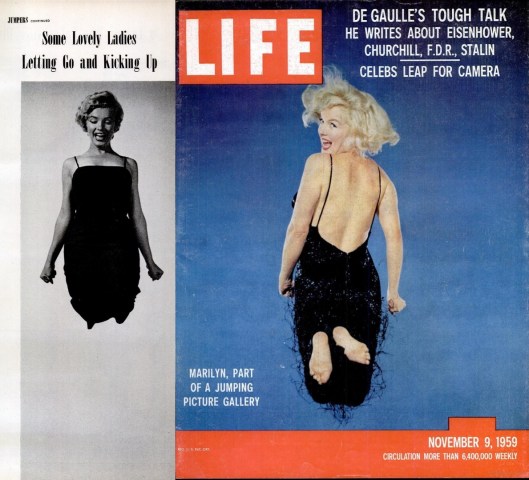
Marilyn was initially unnerved by the description, and an earlier attempt from 1954 had fallen short. After Halsman held her hand for a dummy photo, she relaxed – and the resulting images were vital enough for a cover story in LIFE magazine. Separately, a candid photograph shows Marilyn conferring in the studio with Halsman while her playwright husband Arthur Miller looks on, suggesting a parity between photographer and model.
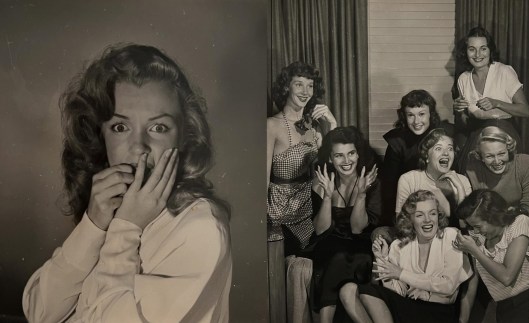
Framed photographs from their earlier sessions, all in black-and-white, adorn two adjacent walls. In 1949, Marilyn was a little-known actress with only four minor film credits to her name. She was first photographed by Halsman for a LIFE feature, ‘Eight Girls Try Out Mixed Emotions.’ One of four solo poses shows her cringing with fear at the sight of an imaginary monster, like the heroine of a sci-fi movie. In an outtake she is shown with seven other actresses, all laughing.
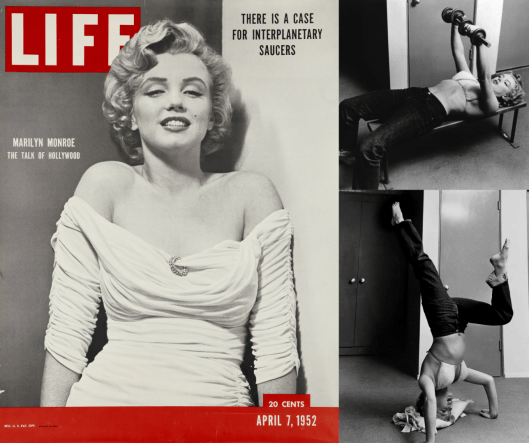
LIFE was America’s leading news weekly, and Halsman shot Marilyn’s first cover at her apartment in 1952. She wore an ivory silk ruched cocktail dress off the shoulder, and stood hunched in a corner for the cover shot, headlined ‘The Talk of Hollywood.’ In contrast to this ethereal guise, she’s also shown lying on a bench lifting barbells, in a towelling bikini top and jeans.
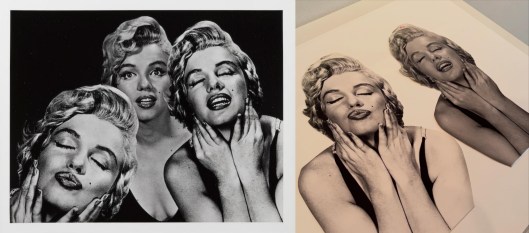
 By 1954, when Halsman photographed Marilyn in New York, her platinum blonde metamorphosis was complete. He later cut out headshots from this sitting, collating three images into a print with a somewhat ironic title, ‘The True Marilyn’ – implying that her identity could not be pinned down. This was one of two photographic manipulations featured in a Monroe-themed portfolio of ten prints, released by Halsman’s estate in 1981.
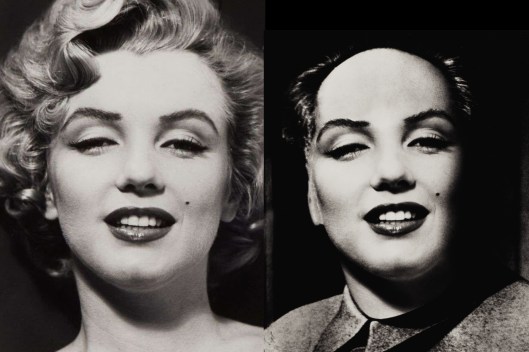
Returning to their first LIFE cover shoot, Halsman superimposed Marilyn’s face onto that of Mao Zedong – with the cut between her eyebrows to the Chinese premier’s forehead left intact, alongside his grey army shirt – in a satirical commentary on opposing spheres of fame (and, perhaps, the dangers of idolatry), utilised by the Spanish surrealist Salvador Dali in a 1971 photomontage for the cover of Vogue magazine.
Starting Out
The exhibition unfolds between a warren of rooms, each painted in shades of lemon, lime, and white. Each room revisits a touchstone of Monroe’s career, and on opening night, I’d reached the end before I found the beginning. At eighteen, Norma Jeane Dougherty was working at the Radioplane munitions plant in Burbank, California, when David Conover, a US Army photographer, ‘discovered’ her in 1944. She was signed by the Blue Book Modelling Agency in Los Angeles, and over the next year, appeared on dozens of magazine covers, shifting from girl next door to pin-up.
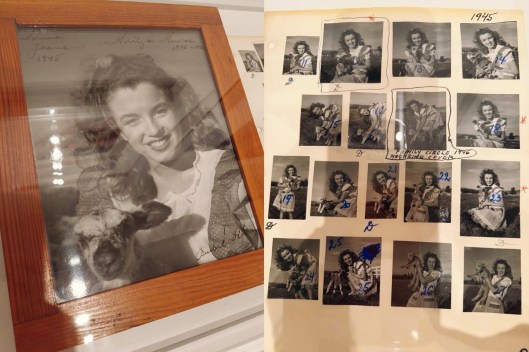
The most creative of her early photographers, Andre de Dienes, was born in Hungary, and specialised in two subjects: the natural world, and the female body. He shot Norma Jeane’s first magazine cover for Family Circle in 1945. Wearing a milkmaid’s pinafore and a ribbon in her hair, Norma Jeane cradled a newborn lamb. They had a brief affair, probably more ardent on his side than hers as she was then married to a sailor serving overseas in World War II.
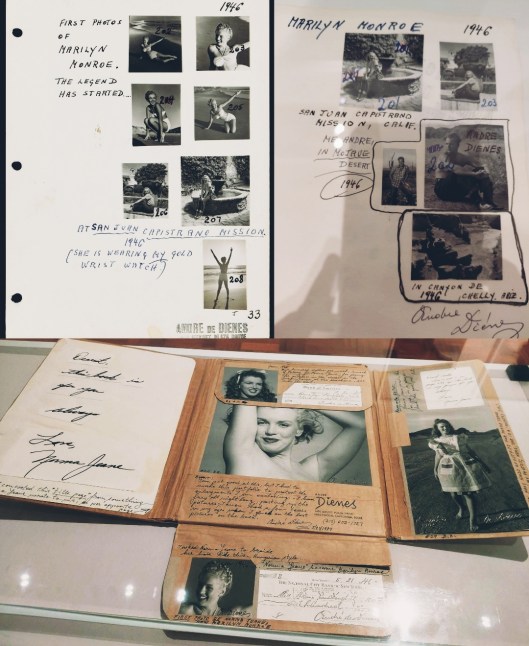
Displayed in glass cases, pages from De Dienes’ contact print journal and collaged ‘shrine’ – including a cheque made out to Norma Jeane, and snippets of her handwriting combined with the photographer’s annotations – chart his journey from unbridled lust to sneaking bitterness as his greatest muse took flight.
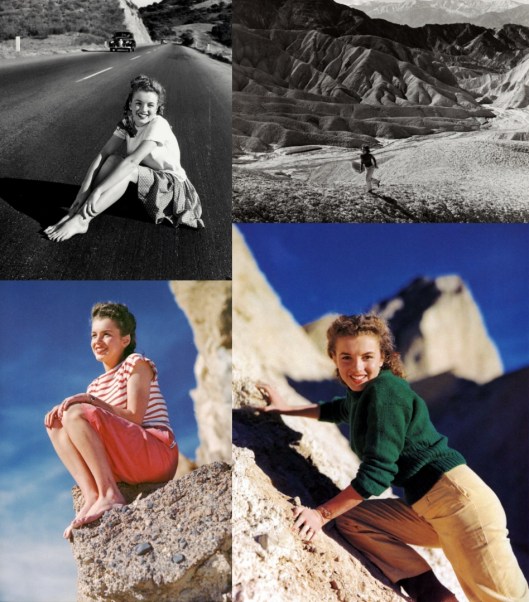
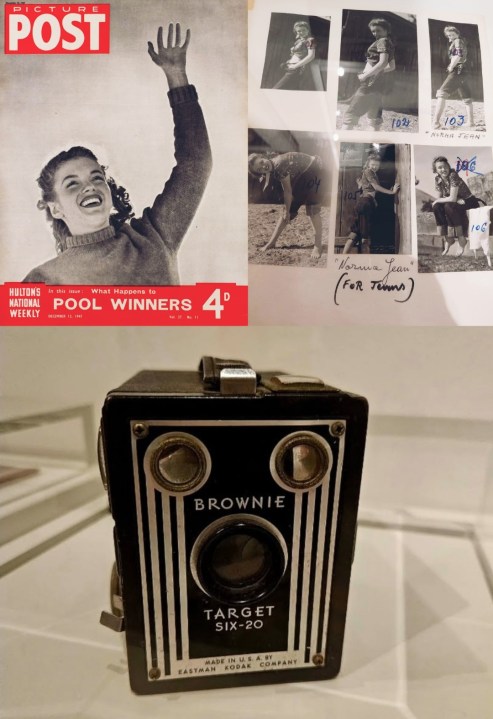
In the first months of their partnership, Dienes drove his California girl through Nevada and Oregon. With her hair in pigtails, and wearing a white t-shirt and a skirt printed with stars, Norma Jeane squatted barefoot on a nearly empty Pacific Coast Highway. Whether perching on a rock in red clam-diggers or running through Death Valley in sweater and khakis, her freshness shone through each exposure. This time of innocence is evoked by original artefacts, including one of her first British magazine covers (Picture Post); a snapshot of Ana Lower, a family friend with whom Norma Jeane lived; and the Box Brownie camera she gave to Norma Jeane, on loan from the Marilyn Monroe Collection of Scott Fortner.
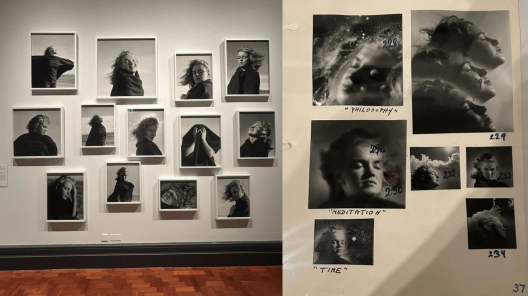
De Dienes was reunited with Norma Jeane in 1946, when she was newly divorced, blonde, and starting out in movies under a new name. “This is the end of Norma Jeane,” she told him on the beach at Malibu, during what has become known as the ‘army blanket sitting’. The shoot was intended to illustrate an unrealised book of poetry and philosophy. A wall is covered with black-and-white images as her mood fluctuates from joy to despair. In Halsman’s terms, these multiples reveal ‘the true Marilyn,’ or rather, the birth of an actress.
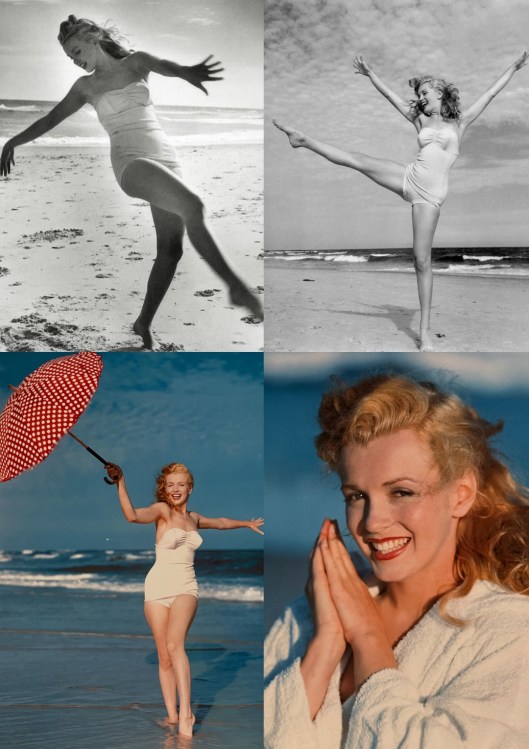
 During her first trip to New York in 1949, Marilyn joined De Dienes on Long Island for what would be their finest hour. Wearing a strapless white bathing suit, Marilyn dances in the sand, her face and body darkened by shadow and her tiptoed feet blurred in motion. Her growing confidence is apparent in a photograph where she stands with hands clasped, her blue eyes mirrored in the sea and sky. She wore a simple white terrycloth robe, a garment (and colour) that would become a signature style for her.
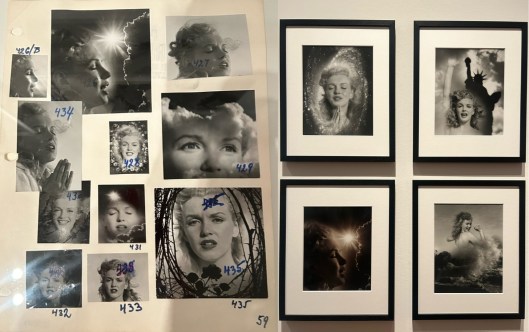
 With a creative vision that spoke to Monroe’s poetic soul, De Dienes experimented with techniques such as solarisation, multiple exposures and montage, taking his mastery of both black-and-white and colour photography to new planes of fantasy. An image of Marilyn in profile, juxtaposed with sunlight bursting through a dark cloud, positions her in harmony with elemental forces. For ‘Invisible Love,’ made after her death, she faces the viewer with eyes shut, smiling faintly amid a silent prayer. She is surrounded by celestial light, probably taken from a separate image captured at the Palomar Observatory in the California mountains. In the third manipulation, she is a goddess rising from the waves; and lastly, her pose with arm raised is shadowed by the Statue of Liberty.
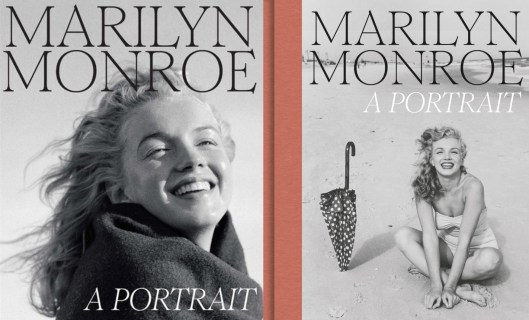
The power of De Dienes’ imagery is acknowledged within this exhibition and its promotional materials. A radiant image from the ‘blanket sitting’ covers the paperback catalogue, available exclusively from the National Portrait Gallery. Another photograph, showing Marilyn sitting cross-legged on the sand at Tobay Beach – with a red polka-dot umbrella leaning upright at her side – covers the hardback edition. The enduring myth of this latter session was recently commemorated with a blue plaque at Oyster Bay.
Unsurprisingly, De Dienes’ work with Marilyn has also inspired artists. An adjacent wall is occupied by Audrey Flack’s 1977 painting, Marilyn Vanitas, part of a series inspired by 17th century still-life painting and the Latin concept of ‘memento mori’ (translated as ‘remember you must die.’) A pioneer of the Photorealist style, Flack recreated a 1949 photograph by De Dienes, placing it within an open book, and opposite a slightly tilted replica in an oval frame. Both objects are placed on red fabric alongside a lit candle, evoking memories of Elton John’s ‘Candle in the Wind’. “I chose a photograph of Marilyn that shows her character in transition,” Flack explained. “Her face retains qualities of Norma Jeane and has not yet fully become Marilyn Monroe.”
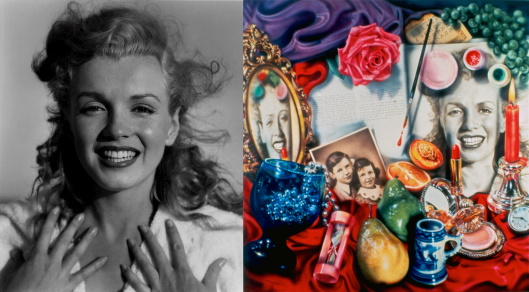
There are also items related to the art of glamour, such as a tube of lipstick and compact mirror; and a string of pearls inside a blue wineglass. A calendar page reminds us of Marilyn’s nude pin-up, but is turned to August 1962, when she died; an hourglass alludes both to her shapely figure and the passing of time, while a small alarm clock denotes her chronic lateness and sudden demise. Framed with grapes and a red rose – the same flower Joe DiMaggio had delivered to Marilyn’s grave every week for 20 years – the painting also includes other ‘perishables’, such as two pears, and an orange cut in half. Finally, a childhood photo of Flack serves as an artist’s signature, and a reminder of lost youth.
“Two images changed the trajectory of Monroe’s career,” writes Rosie Broadley, Senior Curator of Art Collections at the National Portrait Gallery. The first came from a nude calendar shoot with Tom Kelley in 1949, which became a point of contention between Marilyn and De Dienes, as he had been badgering her to pose nude for him for years. It seems likely that she preferred to pose nude for a photographer with whom she had a strictly professional relationship. In the most famous image, labelled ‘Golden Dreams,’ she lies sideways on red velvet, with her face partly concealed; and for another, ‘A New Wrinkle,’ her hair cascades like a Titian beauty’s fiery mane.
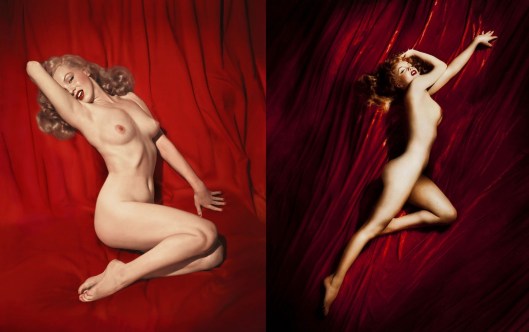
By 1952, this ‘beautiful nobody’ was adorning calendars in garages and barbershops across America. As her film career blossomed, studio bosses pressured her to deny ‘Miss Golden Dreams’ – or as her signature on the release form read, ‘Mona Monroe’ – was really her. She refused, telling reporters she had needed the fifty dollars. Her candour defused what could have been a career-ending disaster, but the image has been endlessly reproduced. Much to her annoyance, it was featured in her first LIFE cover story; and a year later, Hugh Hefner bought the image rights and republished it in the debut issue of Playboy.
After her death, documentary photographer Danny Lyon (best-known for his Bikeriders series) discovered an old calendar hanging from a door in a condemned building, one of many demolished to make way for what became the World Trade Centre. ‘Marilyn, in an Abandoned Building’ was published in Lyon’s 1967 book, The Destruction of Lower Manhattan, which catalogued the erasure of the city’s past in a drive for urban renewal. “I took more than photographs,” he admitted. “In one abandoned room in the vegetable market, I made a photograph of the 1951 calendar of Marilyn Monroe, then I took the calendar too.”
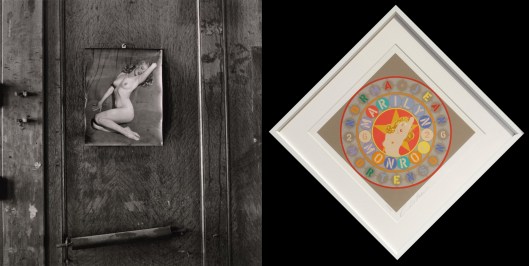
Directly opposite Audrey Flack’s giant Vanitas is The Metamorphosis of Norma Jean Mortenson (1967), a medium-size painting by Robert Indiana. He became interested in Monroe after her death, and was particularly intrigued by the numerical coincidences in her timeline such as her birth-year of 1926 being inverted in the year she died, 1962. Set against a grey background within a diamond-shaped frame, Metamorphosis creates a series of rings, with her ‘Golden Dreams’ torso at the centre. Circled in rings of red to yellow, she appears like a target on a dartboard in one of the male-dominated spaces where her calendars so often appeared.
Monroe’s birth and stage names and aforementioned dates are lined up in a posthumous astrological chart, each letter or number individually encased like rotary dials on the telephone she was clutching when she passed away. Indiana, who like Warhol was a gay man identified with the Pop Art movement, is best-known for his LOVE sculpture of 1970. One of his few works in acrylic, Metamorphosis represented “a divergence in my own style … a warmth and glow from the pastels which I had never striven for before.”
In an adjoining room, we find images captured by just a handful of the many who photographed Marilyn in the early years of her career, when she supplemented occasional bit parts in films with more frequent modelling jobs. Joseph Jasgur, born in Canada to Russian immigrant parents, established himself in wartime Los Angeles as the official photographer of the Hollywood Canteen. Emmeline Sniveley, head of the Blue Book Agency, sent Norma Jeane to make test shots with Jasgur in his studio in March 1946. Afterwards, she joined him in the darkroom, fascinated by the development process.
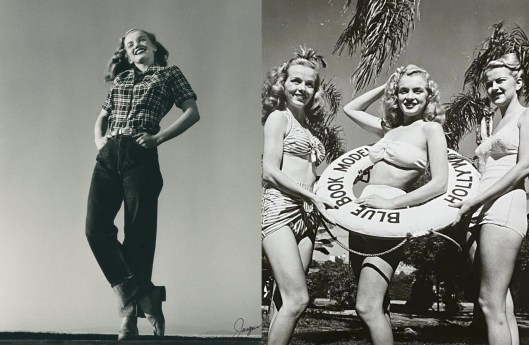
Jasgur would tell Sniveley that Norma Jeane’s hair was too dark and her smile needed work. Nonetheless, several more shoots were arranged. Joking that he could take her “to the top of Hollywood,” Jasgur photographed her at the Don Lee transmission tower above the Hollywood sign. Wearing her own clothes – a simple plaid shirt with belted dark jeans – she stands with her hands in her pockets, one booted foot tucked behind the other. Shot from below, the day’s photographs weren’t especially flattering but she smiled gamely.
A few months later, Jasgur visited the Blue Book headquarters at the Ambassador Hotel on Wilshire Boulevard for a group shoot with Norma Jeane and other models, all clad in swimwear. Her hair had been lightened and her grooming was more polished. She stands in a white two-piece bathing suit with a lifebuoy bearing the agency’s name around her torso, held up by two other models. This ‘graduation ceremony’ was effectively a publicity stunt for the agency,
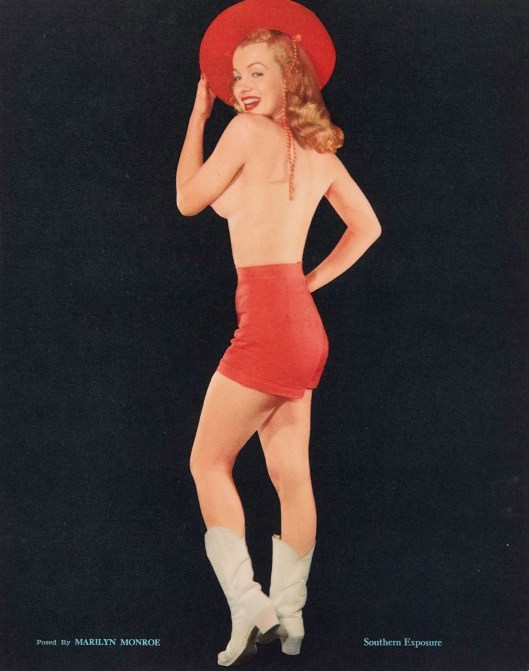
Whereas Jasgur recognised her wholesome, ‘girl-next-door’ quality, he lacked the artistry of Andre de Dienes. After being dropped from her first contract with Twentieth Century-Fox in 1947, photographers like the Hungarian-born Laszlo Willinger – formerly a studio portraitist at MGM – exploited Marilyn’s nascent sex appeal within the ‘cheesecake’ conventions of the era. In a colour pin-up shot, she stands topless in red shorts and white cowboy boots with her back to the camera, peering around in a red tilted hat. In around 1950, this was published with the caption ‘Southern exposure’, alongside another mildly titillating shot captioned ‘Caught short’ in which she faced the camera with arms folded over her chest. Reflecting her growing fame, Monroe was named in both shots.
Born into poverty in Germany, Bruno Bernard was raised in an orphanage and fled persecution in Hitler’s Berlin to become America’s most famous pin-up photographer. In September 1945, when leaving a dentist’s office, Bernard spotted an attractive young woman crossing the street and gave her his business card. She arrived at his studio on Sunset Boulevard the next day, beginning a sporadic collaboration that spanned almost a decade.
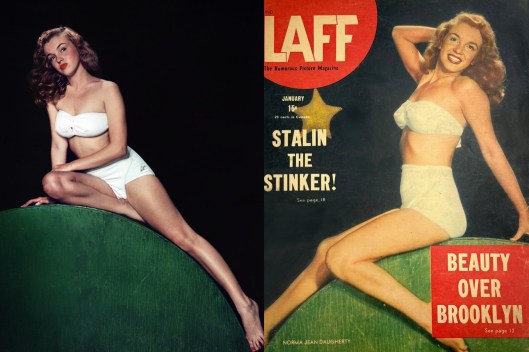
In a studio shoot from this period, she wore the same white two-piece she later modelled for Jasgur. Perched atop a plush green barrel, her expression betrays a latent boredom. A more poised image from this sitting made the cover of Laff magazine in 1947, where she was billed as ‘Norma Jean Daugherty’ (with both her birth and married names misspelled.) On a small screen, we can watch her posing in the studio, as part of a short film, Seven Sirens, shot by Leo Caloia who had also filmed her with other models at the Ambassador Hotel.
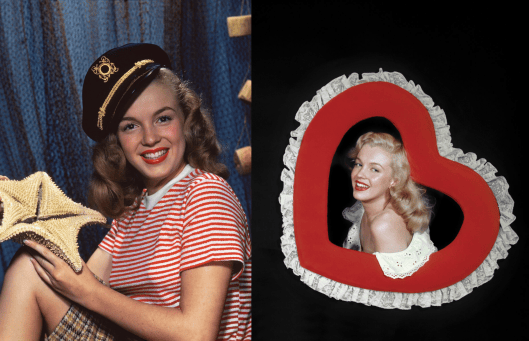
For the kitschy ‘Sailor Girl’, she wears a striped t-shirt and checked shorts with a nautical cap tipped at a jaunty angle, while clutching a prop starfish. ‘Valentine‘ uses the same red-black colourway as Willinger’s topless shoot, but with a coy charm. Marilyn appears within a heart-shaped backdrop, with white lace drooping from her shoulder. The same image has been deployed as a ‘grotto’ where fans can pose with Monroe as part of another centennial exhibition, Marilyn Monroe: Hollywood Icon, at the Academy Museum in Los Angeles.
In the spring of 1949, Marilyn visited Palm Springs with her much-older (and married) boyfriend, Hollywood agent Johnny Hyde. They stayed at the Racquet Club, a celebrity hotspot where Bruno Bernard kept another studio (the third was at the Flamingo Hotel in Las Vegas.) In one colour photograph, she sits on the edge of a diving board in a blue two-piece bathing suit; in another, she stands larger than life in open-toe sandals with cork wedge heels – anticipating Seward Johnson’s giant ‘Forever Marilyn‘ sculpture that is now the subject of raucous debate in downtown Palm Springs.
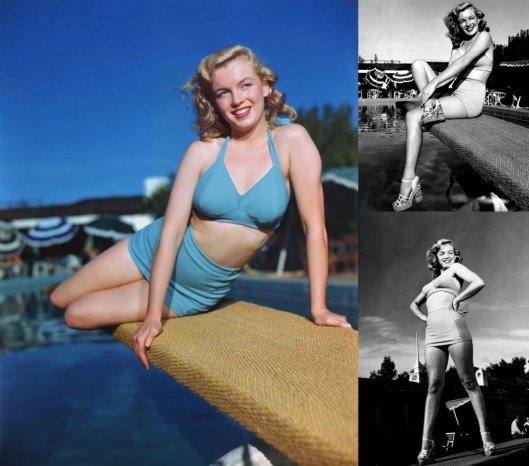
Although it has been claimed that Bernard introduced Marilyn to Hyde – who helped her win a breakthrough role in All About Eve (1950), and a seven-year contract at Fox, the studio that previously dropped her – it is generally thought that they had met at a New Year’s Eve party in 1948, and made the trip to Palm Springs together. Bernard photographed the couple again when they returned to the resort that December, but Hyde would not live long enough to see his plans for Marilyn’s career fulfilled.
After shooting Niagara in 1952, Marilyn posed for Bernard in a red duplicate of the pink peekaboo dress that so inflamed Joseph Cotten in the movie, and with a studio backdrop standing in for Niagara Falls. By then, she had transitioned from pin-up model and cover girl into America’s sexiest actress. In the age of Kodachrome, Bernard’s grasp of colour was rivalled only by Richard C. Miller, a lesser-known photographer who also worked with Marilyn in the early stages of her career. Bernard was also able to combine her girlish quality and nascent sex appeal in ways that Jasgur and Willinger could not.
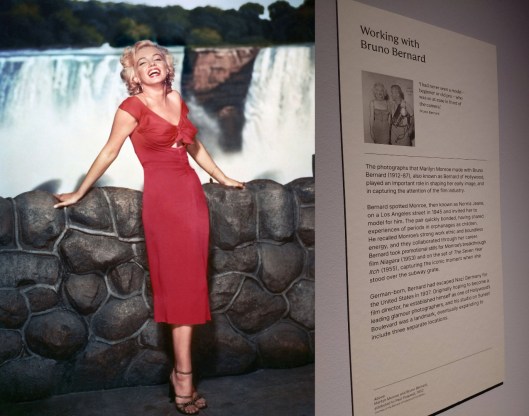
However, Marilyn’s later sittings with Bernard are the object of confusion, as some photos from this era credited to the self-styled ‘Bernard of Hollywood’ are thought to have been wrongly attributed, including many glamour shots widely reproduced today. One of these, showing Marilyn in a black bathing suit and high heels, may have been shot by Frank Powolny, who headed the portrait photography department at Twentieth Century-Fox. The studio is named alongside Monroe at the foot of this print, titled ‘Greetings.’
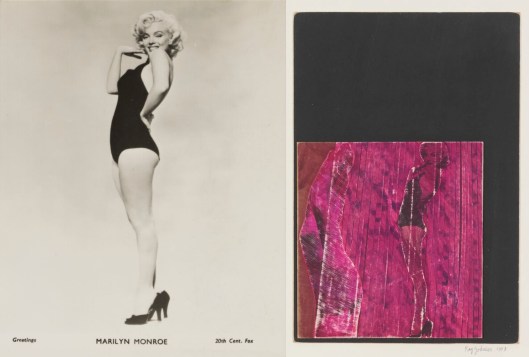
In 1958, collagist Ray Johnson affixed this image alongside another photograph of a cupped hand onto the lower half of a larger piece of dark blue board, and overlaid both images with strokes of violet tempera. This proto-Pop Art work, Hand Marilyn Monroe, positions her just beyond the reach of a disembodied hand, like a modern Venus veiled in gauze.
Bernard was not quite the pivotal figure suggested by a recent Hollywood Reporter article proclaiming him ‘The Man Who Invented Marilyn’. During this period Marilyn worked with many other skilled photographers, including the aforementioned Miller, Earl Leaf, Earl Thiesen, Ernest Bachrach, Jock Carroll, Ben Ross, Nickolas Muray, and Frank Worth. What distinguished Bernard from his peers was his ability to tell a story, crossing boundaries between fact and myth.
Becoming a Star
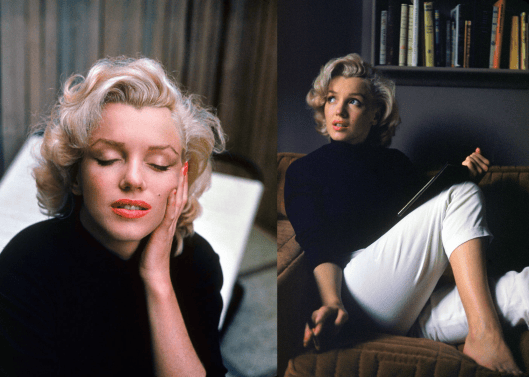
A long hall, extending directly from Pauline Boty’s Colour Me Gone, showcases four photographers who captured something more intimate than clichéd Hollywood glamour at the height of Monroe’s fame. First, we return to Alfred Eisenstaedt whose steely-eyed portrait dominates the entrance to this exhibition. A contact sheet published in the catalogue reveals other moods conjured during the shoot. Keeping the black polo-neck sweater, Marilyn swapped her white capri pants for looser gingham trousers, one of several pairs she wore throughout her career, from the De Dienes sessions to the trailers and dressing rooms of her final movie sets. She sits barefoot on a patio lounger, and in a dreamy colour shot, lowers her head with eyes closed.
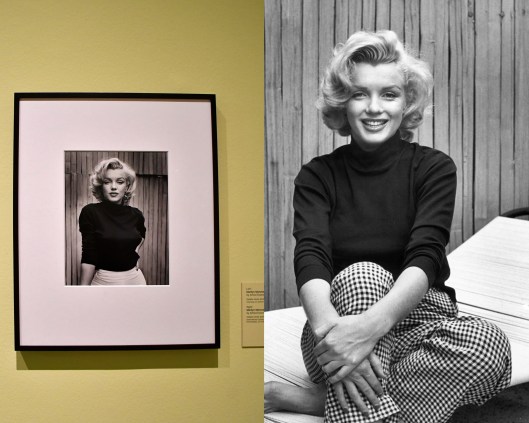 Inside the apartment, she reads while sitting cross-legged on a couch, with a bookshelf affixed above. This image made the cover of Fragments, the 2010 collection of her ‘poems, intimate notes, letters.’ While Eisenstaedt’s photographs of Marilyn are ubiquitous today – with Ana de Armas replicating her Fragments pose for the Netflix biopic, Blonde – they were barely seen in Monroe’s lifetime. Eisenstaedt, born in Poland, made his name in Berlin before moving to New York. He is perhaps best-known for ‘V-J Day in Times Square,’ a candid image of a returning sailor embracing a nurse, published in LIFE magazine in 1945.
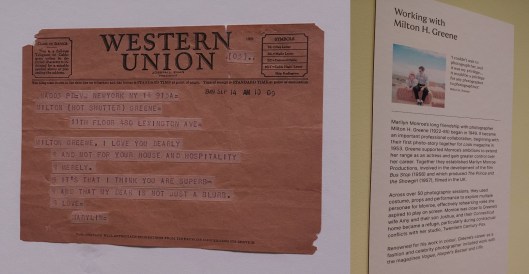
A telegram sent to Milton ‘Hot Shutter’ Greene in September 1949 reads: ‘Milton Greene, I love you dearly/And not for your house and hospitality merely/It’s just that I think you are superb/And that, my dear, is not a blurb./Love, Marylin [sic].’ While Monroe was known to write verses for friends like poet Norman Rosten, this was probably penned by another ‘Marylin’ (perhaps a fashion model.) The telegram was sent from New York, but Monroe was shooting A Ticket to Tomahawk in Colorado at this time. According to Milton’s widow Amy Greene they first met in 1953, when Milton shot a cover story with Monroe for Look magazine. Thus began the most intense partnership Marilyn had forged with any photographer since Andre de Dienes, explored only briefly here.
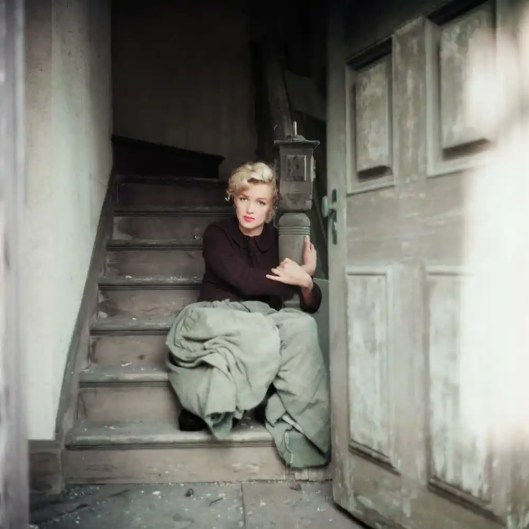
When Milton returned to Los Angeles in May 1954, much had changed. He was married with a baby on the way, and Marilyn had recently wed baseball legend Joe DiMaggio. Their star-crossed union was volatile from the start, and she was also unhappy with her latest ‘dumb blonde’ role in There’s No Business Like Show Business. When not singing and dancing on a soundstage, she took Milton on a tour of the Fox backlot. For the ‘peasant sitting,’ she wore Jennifer Jones’ black jacket and flowing green skirt from The Song of Bernadette (1943), and posed against a French village backdrop from John Ford’s World War I drama, What Price Glory (1952.) She sits pensively on a staircase, as if contemplating other roles she might play onscreen, and in life.
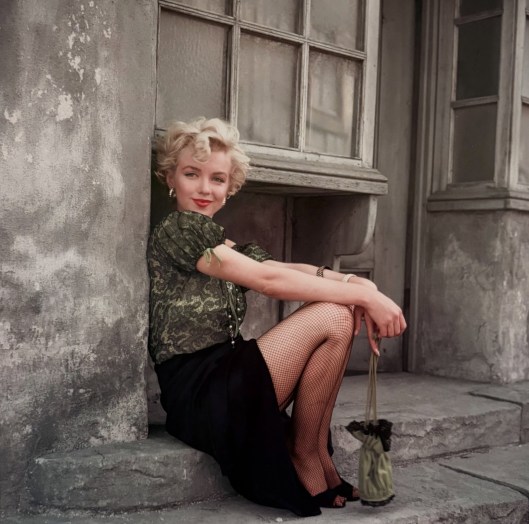
 She plundered the Fox wardrobe again, borrowing Susan Hayward’s green lace blouse and black pencil skirt from I’ll Cry Tomorrow (1952), worn with fishnet stockings and anklet in what was later dubbed ‘the hooker sitting’, although for this exhibition, the image is retitled ‘London Girl.’ She would wear the same costume in Bus Stop (1956), but the wedding ring on her finger dates this series back to the DiMaggio era.
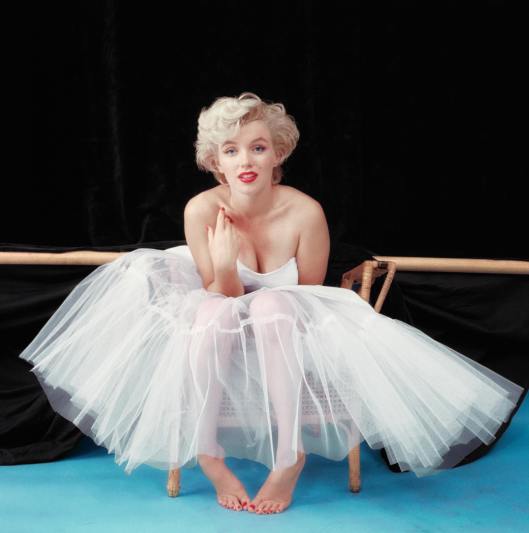
By September 1954, when Marilyn flew into New York, her marriage was on the rocks. A certain weariness is evident in a colour photograph from the ‘ballerina sitting’, shot in Greene’s studio on Lexington Avenue. She sits on a wicker chair against a backdrop of black wall and turquoise floor. Her white tutu was too small, and was left open at the back. Her legs can be seen through the netted skirt, with feet turned inward. Her left arm rests on her knee, and her fingers are raised towards her collarbone. Her red lipstick and matching nail polish completes the palette. Monroe’s most ‘painterly’ photographer, Greene blended darkness and light to create their most iconic portrait.
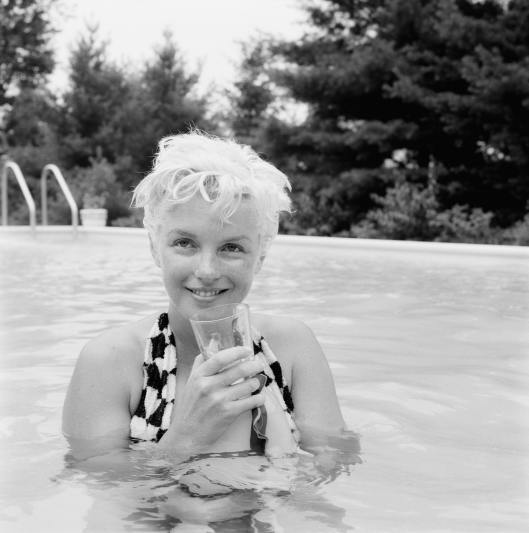
A few weeks later, the DiMaggio marriage collapsed; and by year’s end, Marilyn had left Hollywood and her seven-year contract behind. After spending Christmas at the Greenes’ home in Westport, Connecticut, she moved to New York and announced the formation of Marilyn Monroe Productions, with Greene as her business partner. During the summer of 1955, Marilyn visited the Westport home of composer Richard Rodgers with the Greenes, and was photographed in the pool. With little make-up, tousled hair, and wearing a harlequin-patterned bikini top, she raised a glass of her favourite champagne; perhaps toasting her newfound freedom even as battle loomed in Hollywood.
Born in Philadelphia to Russian immigrant parents, Eve Arnold was the first female photographer to join the Magnum Agency, an international press co-operative; and the only woman to photograph Marilyn extensively. After meeting Eve at a party in New York, Marilyn called her in August 1955 with an unusual assignment: she had been invited to visit the small town of Bement, Illinois, then celebrating its centennial anniversary. Marilyn viewed exhibits related to Abraham Lincoln, whom she greatly admired, before judging a contest of local men who had grown beards in Lincoln’s honour.
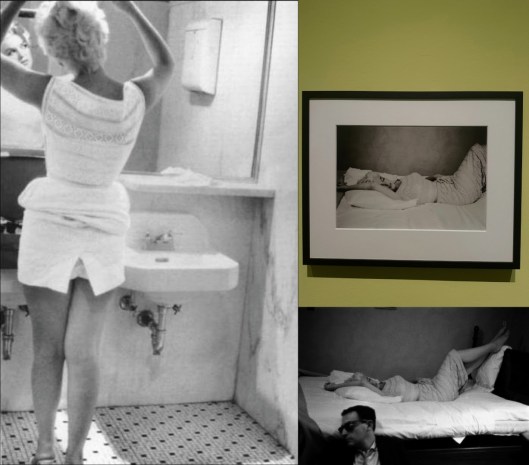
In one photograph, Arnold shows Marilyn standing in a rather shabby bathroom during a layover at Chicago’s Midway Airport. With her back to the camera and her white dress hitched up to her waist, we see Marilyn’s face reflected in a mirror as she combs her hair. In a second image captured after her arrival in Bement, she takes a brief rest on a bed. The photograph has been cropped, as the original image showed her hairdresser, Peter Leonardi, sitting on the floor. Arnold related to Marilyn as a working woman, and although she remains beautiful in these images, the effort behind her glamour is subtly exposed.
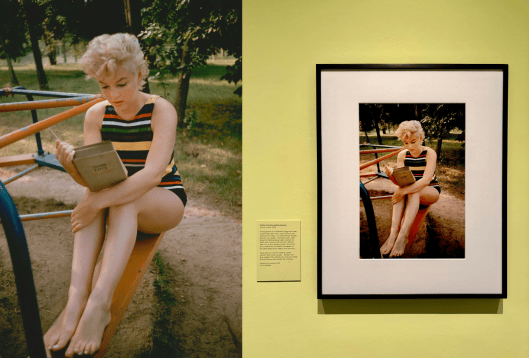
A colour photograph, shot a month later in a children’s playground at Mount Sinai on Long Island during the Labour Day weekend, shows Marilyn reading from her own copy of James Joyce’s Ulysses. Arnold’s most famous portrait has graced the covers of numerous books and literary magazines, courting speculation about Marilyn’s reading habits. In fact, she owned more than 400 books, and was then studying the Molly Bloom soliloquy that closes the novel for an acting exercise. She often posed while reading, perhaps hoping to prove her intellect to those who doubted its existence. This image still resonates because Arnold photographed her without judgement.
“Miss Marilyn Monroe calls to mind the bouquet of a fireworks display,” Cecil Beaton wrote after photographing her for Harper’s Bazaar in 1956. “She is as spectacular as the silvery shower of a Vesuvius fountain; she has rocketed from obscurity to become our postwar sex symbol – the pin-up girl of an age. And whatever press agentry or manufactured illusion may have lit the fuse, it is her own weird genius that has sustained her flight.”
Beaton’s career began in the 1920s with his theatrical set designs and distinctive portraits of London’s ‘bright young things.’ He was later appointed as official photographer to the royal family, and photographed Queen Elizabeth II on the day of her coronation in 1953. Marilyn arrived at his suite in the Ambassador Hotel on Park Avenue, Manhattan and sat down on a wicker chair, covering herself protectively in a white fur coat. She then removed the coat and lay down on a white couch, clutching a cushion and grinning mischievously. Her black velvet cocktail dress had recently made headlines when one of the spaghetti straps snapped during a press conference.
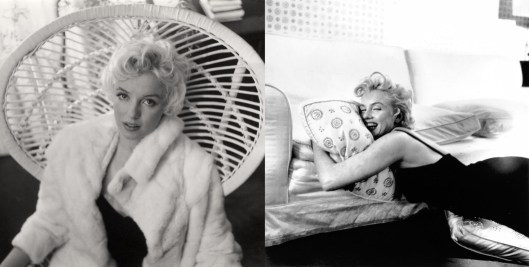
“There is an unworldly, a winsome naiveté about the child’s eyes that, quick as a flash, will screw up into a pair of sexy, smouldering slits and give you a synthetic ‘come-hither’ look,” Beaton observed. “In her presence, you are startled, then disarmed, by her lack of inhibition. What might at first seem like exhibitionism is yet counterbalanced by a wistful incertitude beneath the surface.”
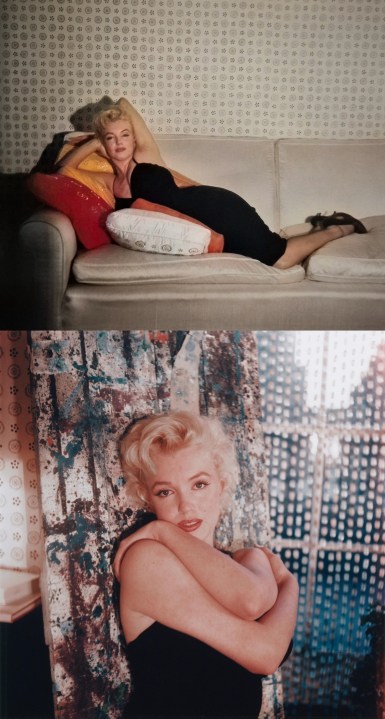
In a lesser-known colour image, Marilyn is framed by his furnishings: cushions in ripe shades of red, yellow and orange are piled onto the couch, transforming her from silver-screen to a Technicolour vision with scarlet lips and golden hair; while the wallpaper pattern of grey orbs over white blends with the couch, and her alabaster skin. Another photograph shows her standing by a window, with a curtain patterned in watercolour splashes matching her blue eyes, as net veils the city outside. Her arms are raised above her head in a flashback to her pin-up days, but her gaze is searching. “The real marvel lies in the paradox—somehow we know that this extraordinary performance is pure charade, a little girl’s caricature of Mae West,” Beaton reflected. “The puzzling truth is that Miss Monroe is a make-believe siren …”
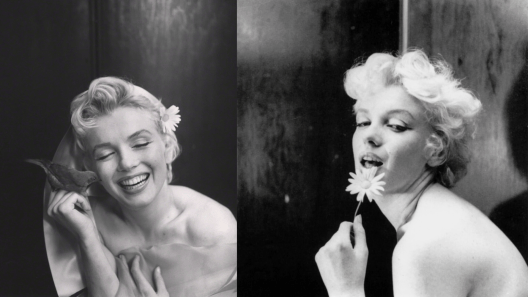
Marilyn changed into a Grecian-style gown and posed with props drawn from Beaton’s theatrical milieu. Wrapped in silky folds, with an artificial flower in her hair, she clutches a stuffed bird. In another image she is bare-necked, pressing the flower to her open lips. “She puts a flower stem in her mouth, puffing on a daisy as though it were a cigarette,” Beaton wrote. “Equally impromptu is her general appearance. This canary blond nymph has been so sufficiently endowed by nature as to pay no attention to the way she looks. Her hair, her nails, her make-up, have a makeshift, spontaneous attractiveness. It is all very contemporary …”
She lay in bed with a flower in hand for another portrait, one of many duplicates she gifted to friends; while film director Joshua Logan gave her a framed triptych on her 30th birthday, with the photograph flanked by Beaton’s handwritten text. She placed it on the white grand piano in her Manhattan apartment, and it was sold for $145,500 at Christie’s in 1999. Vogue editor Diana Vreeland chose a variant image for Allure (1981), a book showcasing her favourite photographs, edited by none other than Jacqueline Kennedy Onassis. “Marilyn Monroe! She was a geisha,” Vreeland mused. “She was born to give pleasure, spent her life giving it – and knew no other way.”
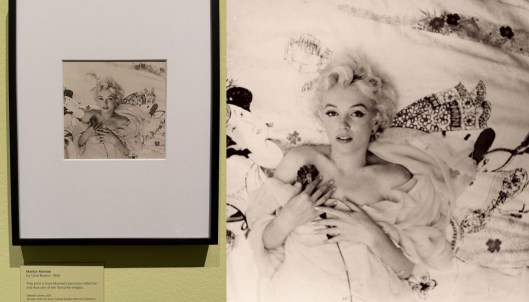
“The Cecil Beaton portraits I find a little cluttered,” Andrew O’Hagan opined in the London Review of Books. “Too much texture around Marilyn always takes away from her (she is too much texture herself). But one of his, showing her clutching a carnation to her breast and relaxing her gaze, was among Marilyn’s own favourites and it shows her experimenting with more natural ways of distilling herself.”
By the mid-1950s, the closed door of Hollywood’s studio lots was breaking open with an increase in location shoots and freelance photojournalists joining forces with movie publicists to create more candid images than in-house still photographers proffered. Marilyn came to New York in 1954 to film exterior shots for The Seven Year Itch, adding local colour to this light sex comedy (originally a Broadway play) which became one of her most popular films, and using the city as a backdrop for a new chapter in her star narrative.
While Billy Wilder would supplant director Howard Hawks (Gentlemen Prefer Blondes) as her greatest comedy mentor – they later reunited on Some Like It Hot – she also collaborated closely with photographer Sam Shaw, a native New Yorker whom she had driven around Hollywood during her lean years. He accompanied her to a brownstone house on East 61st Street where her character – known only as ‘The Girl’ – is subletting an upstairs apartment.
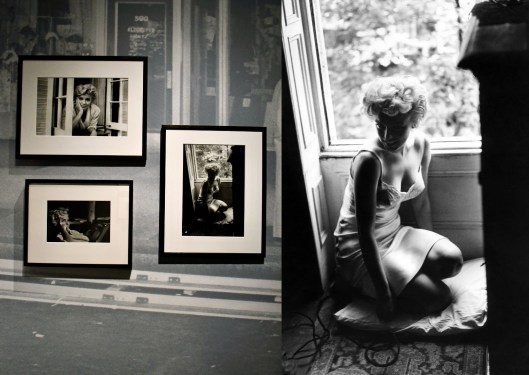
In two short scenes, she waves from a window to her downstairs neighbour. In the first, she is wearing a satin slip and holding a hair dryer above her head. While dozens of photographers gathered on the street, Shaw joined her inside the house where she sat on a cushion between the window shutters, and a shadow fell across her face with a gentle caress.
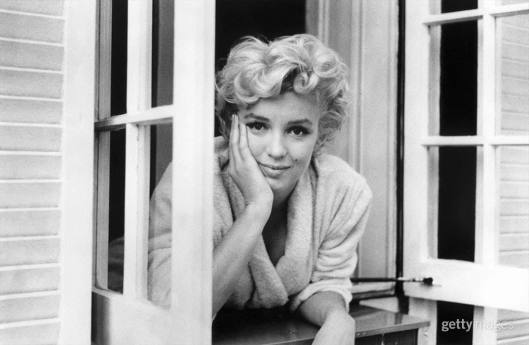
For the second scene, Marilyn covered her slip with a white terrycloth robe. This would be the film’s closing sequence, as her downstairs neighbour (Tom Ewell) leaves the sweltering city behind to join his wife and son on vacation in airy Maine. Leaning on the window frame, she rests her head on hand and smiles wistfully at Shaw, creating a moment of intimacy amid the hubbub. She would later write ‘this is my favourite’ on a print that Shaw collated into a scrapbook.
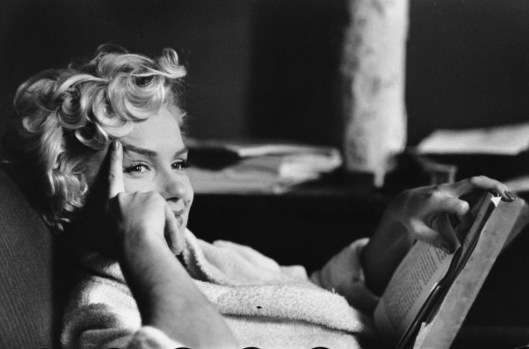
However, Shaw wasn’t the only photographer on the scene who saw something in Marilyn beyond the sexpot cliché. Elliott Erwitt, who worked alongside Eve Arnold and others at the Magnum Agency, photographed Marilyn for the first time on that day. During a break from filming, Marilyn rested on a couch inside the house where Erwitt photographed her leafing through the script, with a hand across her cheek as its index finger pushes her eyebrow upward in a subtly ironic gesture.
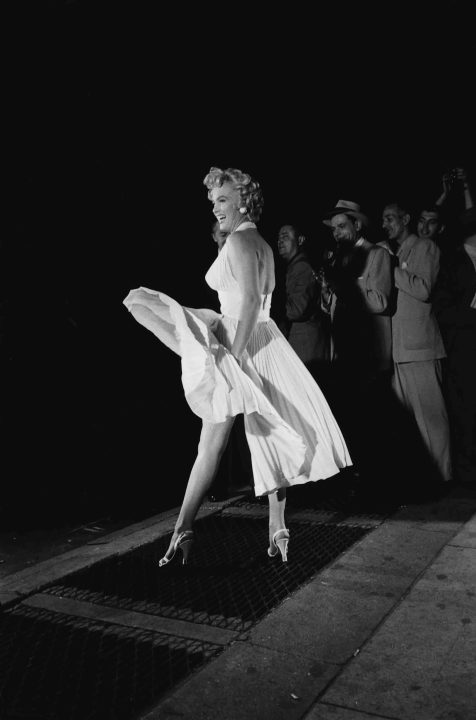
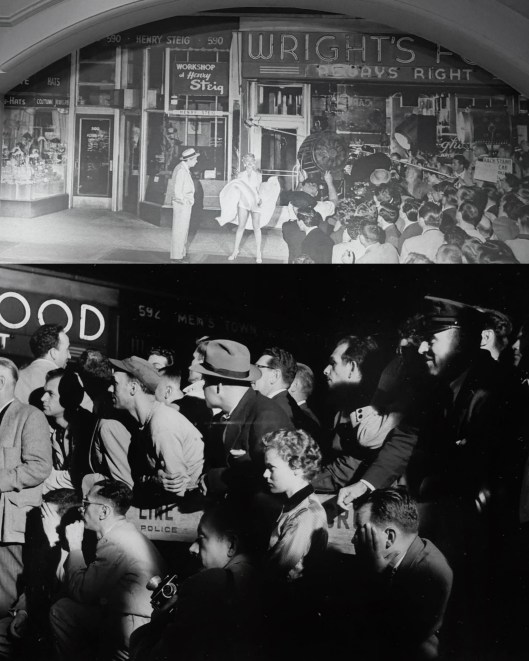
Days later, the crew moved to the intersection of Lexington Avenue and 52nd Street, where Monroe and Ewell were filmed leaving a movie at the Trans-Lux Theatre. In this famous scene, Marilyn stands over a subway grate and cools off as the evening breeze rises from an incoming train below – which was, in fact, a wind machine operated by a studio grip perched directly under the grate – blowing the skirt of her white dress around her waist. A large crowd gathered during the four-hour shoot, with Sam Shaw foremost among the numerous photographers who captured hundreds of images from the multiple takes.
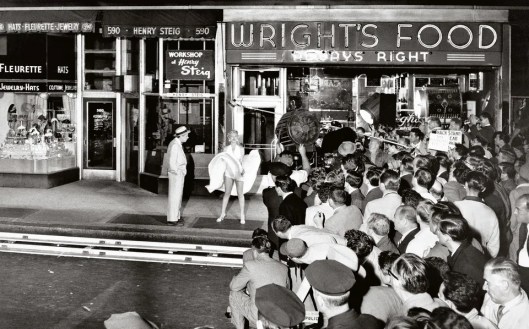
The Seven Year Itch photographs appear at the end of this corridor, with a long-shot by Shaw papering the arched wall. The stars are just two figures within a wider landscape, standing in front of a jewellery and a grocery store. A cluster of men surround the bulky film cameras at their side, including reporters, onlookers, and two uniformed police officers. And in two framed images, Shaw moved closer to the heart of the spectacle. In the first, a film still, Monroe pushes her skirt down laughingly while Ewell looks on, casting a noirish shadow. More prosaically, a fire hydrant can be glimpsed from the wall between two shopfronts.
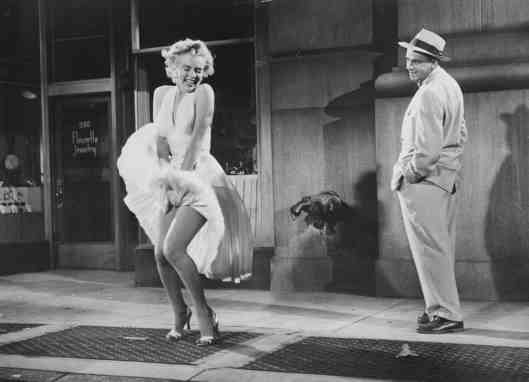
Ewell is absent from the second image, which shows Marilyn alone on the grate, with a crew member operating a spotlight from behind and reporters leering in the same manner performed by Ewell. “She is a vision in white,” Monroe biographer Lois Banner wrote of this photograph. “With her head held high, a smile on her face, and her body seemingly in motion, she resembles an exotic butterfly …”
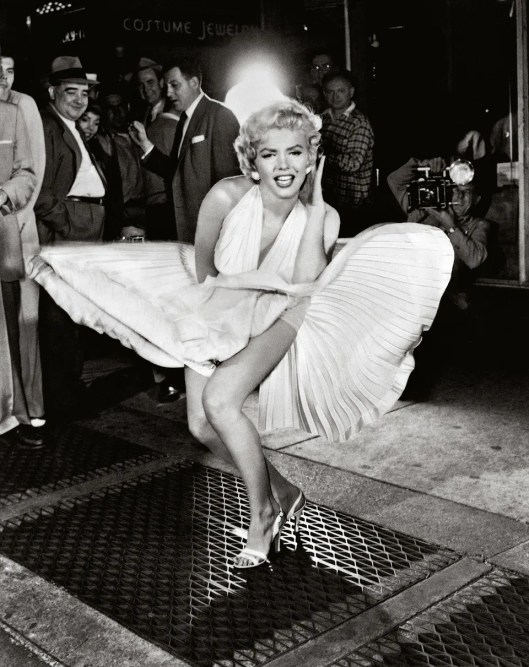
While Shaw’s photographs were singular (and definitive), other photographers captured the moments in-between, when the image was in process but not yet complete. In fact, so many images were shot that it is difficult to discern one photographer’s work from another. In one image (possibly by Matty Zimmerman), the eye is drawn to Tom Ewell, partially cut from the frame. His suit is accessorised with a bowtie and a pork-pie hat, and he brandishes a cigarette holder in a middle-aged man’s attempt at sophistication, while Marilyn embodies the youthful beauty he can never possess. In another photograph (perhaps by Arthur Fellig), her face is covered entirely by her billowing skirt, with only a few blonde locks on top still visible. This is a press print, with the number ‘4’ tacked to the bottom left corner, and a section torn off at bottom right.
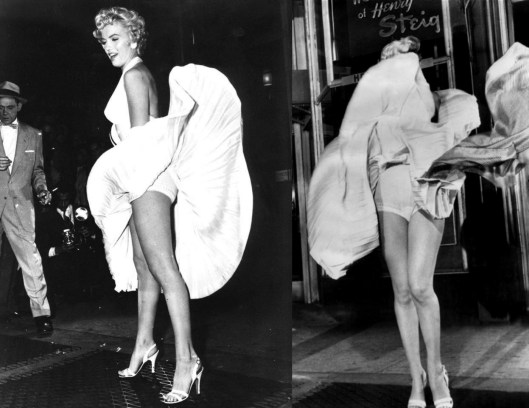
Marilyn’s white stiletto sandals – designed by Italy’s ‘shoemaker to the stars’, Salvatore Ferragamo – are prominent in both images, while in a third photograph by Elliott Erwitt, her faux pearl and rhinestone earrings gleam in the distance as she strikes a powerful stance. This was one of seven images depicting the scene at different stages, chosen by Erwitt for his Sequentially Yours exhibition at London’s Atlas Gallery in 2010. “The process is sometimes more interesting than the finished picture,” he told TIME magazine. “You always look for the best picture, but sometimes the pictures are not that great alone. But in a group, they become interesting.”
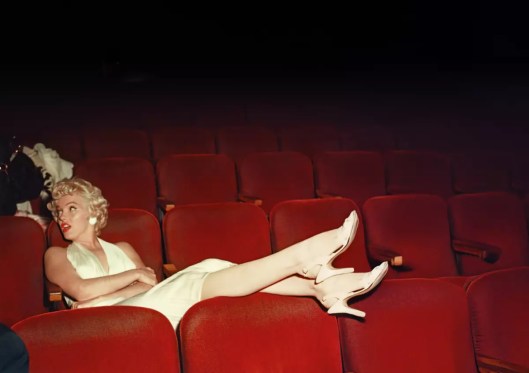
Erwitt was one of the few photographers who also shot in colour that evening. Another was Bruno Bernard, who captured Marilyn relaxing inside the Trans-Luxe Theatre, which was closed to the public. She sits with her feet up, arms and legs folded casually, her red lipstick matching the cinema’s plush seating. Although clearly aware of Bernard’s camera, she appears to be in conversation with someone outside the frame – possibly Billy Wilder, Joe DiMaggio, or another crew member. Clothing is heaped on the row behind her, and the darkened wall reminds us that this star was sheltering in a cinema. This image was also used in poster art for Marilyn Monroe: Self-Made Star, a centennial movie retrospective at the British Film Institute.
The promotional value of the New York shoot was immeasurable, as images were circulated in newspapers and magazines long before The Seven Year Itch was finally released, almost a year later. However, the New York footage was unusable due to crowd noise; and the raucous evening hastened the collapse of her nine-month marriage to DiMaggio. The scene was reshot on a Hollywood soundstage in late 1954, with Bernard invited to the set alongside Sam Shaw and Milton Greene. A contact sheet print shows Marilyn re-enacting her subway grate scene, and among the photographer’s markings is a squiggle beside Tom Ewell in an image of Marilyn that has been widely reproduced with her co-star cut from the frame.
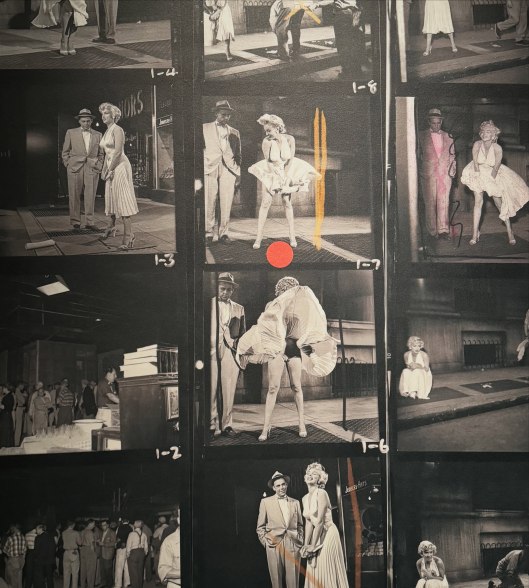
This would be Bernard’s last photo shoot with Marilyn, although in 1999, one of his New York photographs was named ‘Symbol of the Century’ by the Museum of Modern Art. A lenticular version of this image adorns the cover of The Marilyn Monroe Century, a new book co-written by Bernard’s grandson, Joshua Miller.
And in the final photograph of this series, we return to the New York crowd, captured up close by Sam Shaw. Among the mostly male onlookers – including one gentleman in a porkpie hat similar to Ewell’s, and another wearing a baseball cap – a young woman watches intently. On another humid evening, as the exhibition’s visitors clustered along the hallway, I felt like part of that crowd from over seventy years ago.
When The Seven Year Itch premiered at the Loew’s State Theatre on Times Square in 1955, a giant cutout from Sam Shaw’s still photo of Marilyn was affixed to the exterior, with replicas then dispatched to cinemas nationwide. “That’s the way they think of me, with my skirt over my head,” she said wryly, while passing by unnoticed with actor Eli Wallach. “She didn’t seem to mind,” he recalled. “She accepted it.”
This image, in all its variations, cemented Marilyn’s status as America’s sex symbol, much as the discovery of her nude calendar had first done a few years earlier. As Rosie Broadley wrote in an essay for this exhibition, the shoot is recognisable “even to those who know little of Monroe’s wider repertoire of movies and photographs. It is the ‘look’ that impersonators most frequently emulate and in which all of Monroe’s personal and professional triumphs and tragedies have become enshrined.”
To be continued…


You must be logged in to post a comment.