Tags
Art Decades, Bruce Davidson, Christie’s, Christopher Gregory, Christopher Logue, Colour Her Gone, Epitaph to Something’s Gotta Give, Gazelli Art House, George Barris, Gone Ladies, John Aston, Lawrence Schiller, Life Magazine, Marc Kristal, Marilyn in Beads, Marilyn Monroe, My Colouring Book, Pauline Boty, Picture Show, Pop Art, Richard Avedon, Some Like It Hot, Something's Got To Give, Sue Tate, Tara Hanks, The Only Blonde in the World, Town Magazine
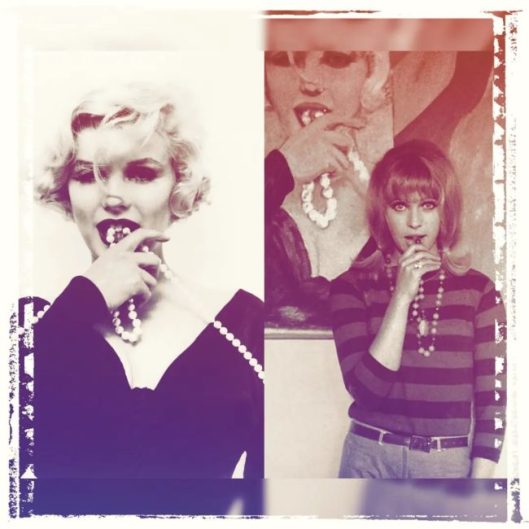
At left, Marilyn Monroe by Richard Avedon, 1959; and at right, Pauline Boty by John Aston, 1962
Pauline Boty was an English pop artist who created three paintings of Marilyn before her death from cancer, aged 28, in 1966. Although neglected for many years, Boty’s work is now being rediscovered – and in March, one of her Marilyn portraits will go under the hammer at Christie’s, as Joe Dziemianowicz reports for Barron’s Magazine.
A portrait celebrating screen legend Marilyn Monroe by British artist Pauline Boty will be a highlight next month at Christie’s London, where the work is expected to sell for between £500,000 and £800,000 (US$631,825 to US$1 million).
Epitaph to Something’s Gotta Give was painted in 1962, the year Monroe died at age 36. The artwork comes to the auction house’s Modern British and Irish Art Evening Sale from an unnamed private collector. The owner was given the artwork by Boty in 1964.
In the world of British Pop Art, Boty became known for vibrant and feminist works. ‘Pauline was very much a pioneer,’ says Angus Granlund, who’s heading up the sale. Before her death in 1966 at age 28, Boty created only around 25 Pop works.

Epitaph to Something’s Gotta Give by Pauline Boty (1962)
The painting headed to auction takes inspiration from Something’s Got to Give, an unfinished screwball comedy starring Monroe directed by George Cukor that shut down production in 1962.
Epitaph to Something’s Gotta Give features bold imagery. Against a red background and streaks of blue there’s the likeness of Monroe in a swimming pool … An image of a statue nods to Boty’s own history.
‘The statue is from a stained-glass window from the Royal College of Art,’ Granlund says. ‘She wasn’t able to enter the painting program there as a woman. So she entered the stained-glass program. So the painting speaks to female empowerment.’
Epitaph to Something’s Gotta Give will be on view at Christie’s in New York from Friday [Feb. 9] to Feb. 21 and in London from March 13-20.
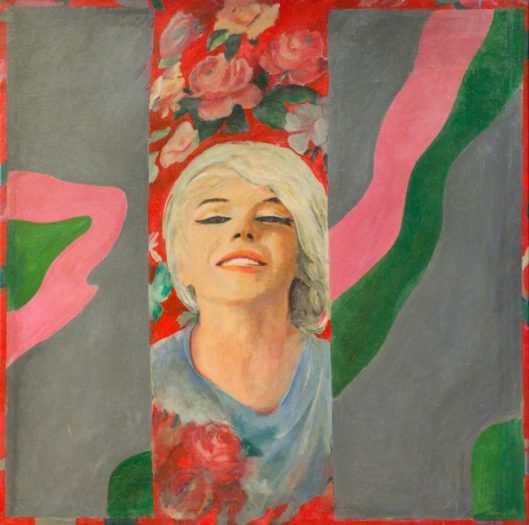
Colour Her Gone by Pauline Boty (1962)
Another of the 1962 portraits, ‘Colour Her Gone,’ is currently on display in a new retrospective, Pauline Boty: A Portrait, at London’s Gazelli Art House until February 24th – and as Jo Lawson-Tancred reports for Artnet, a closer inspection has yielded the answer to a long-held mystery.
As part of the exhibition at Gazelli Art House, art historian Dr. Sue Tate has presented new research on the artist, including a surprise revelation about one of Boty’s standout pieces, Colour Her Gone (1962), on loan from Wolverhampton Art Gallery.
This lively portrait of Marilyn Monroe is a far cry from Andy Warhol’s static image of a sad-eyed starlet that was swiftly mass-reproduced. Under Boty’s brush, Monroe is almost unrecognisable with her head thrown back, windswept hair and wide smile. She is framed by decorative floral motifs and panels with swirling abstract patterns that create a collaged effect.
Tate and her colleague Christopher Gregory had long suspected that beneath the surface there lurked an earlier painting, Marilyn with Beads, a work only known thanks to an archival photograph of Boty in front of the canvas that was taken by John Aston in 1962.
That lost painting had the same flat background marked by whirling ribbons of color that had made its way into the final composition of Colour Her Gone.
A reflectogram study of the painting ordered by Wolverhampton Art Gallery and Gazelli Art House that was able to confirm Tate’s hunch. The scan revealed extensive alterations made to the painting including clear traces of the lost portrait of Marilyn hidden beneath the surface.
‘Here as in other paintings, Boty has radically reworked a composition until she had clinched the image that expressed exactly what she wanted to say,’ Tate said.

Interestingly, the original Marilyn with Beads is a much more stereotypically titillating image of Monroe, which drew directly from a promotional photo of the actress for the film Some Like it Hot (1959). Boty eventually seems to have changed her mind about how best to represent the celebrity, opting instead for an unexpectedly natural, less idol-like depiction.
Thanks to new scanning technologies, art historians have made major leaps in bringing to light unknown masterpieces that were painted over. The discovery shows that Boty’s approach, which has according to Tate been historically dismissed as ‘slapdash,’ was actually highly considered, with complex compositions built up over a long time.”
 In my 2014 article for Art Decades magazine, ‘Pauline Boty: Pop Artist and Woman,’ I explored Marilyn’s influence on her work. Here is an extract with slightly different text.
Pauline was nicknamed ‘the Wimbledon Bardot’ for her resemblance to the French movie star and sex symbol, Brigitte Bardot. While at Wimbledon, she explored collage techniques.
However, her confidence was bruised when she entered the Royal College of Art … She was often broke and at odds with her father, from whom she concealed her most experimental work. Eventually, she left home and moved into the heart of West London’s Caribbean quarter.
While at RCA, Pauline met a group of like-minded artists (including David Hockney and Allen Jones) who shared her ‘proto-pop’ aesthetic, and in 1961 she was invited to exhibit at London’s AIA Gallery alongside Peter Blake. British Pop Art was then dominated by ‘angry young men’, but Boty countered their aggression with an emphasis on women’s desires, and empathy towards female consumers of popular culture.
She was also a prominent member of Anti-Ugly Action, campaigning against dated, derivative British architecture. During one demonstration, Pauline carried a life-size cardboard figure of America’s reigning bombshell, Marilyn Monroe, alongside her as she marched.
Having recently visited America, Boty was galvanised by movies, rock and roll, and the burgeoning radicalism of the civil rights movement. She also impersonated Monroe in college revues, singing ‘I Wanna Be Loved By You’, and a version of ‘Diamonds Are a Girl’s Best Friend’ in which she added her own lyrics, such as ‘my armpits are charm-pits’ (which unsettled some of the audience.)
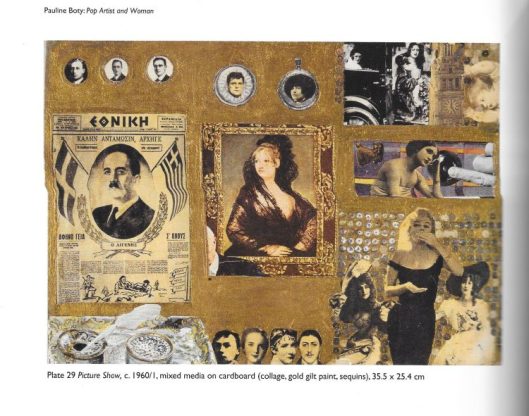
Colour plate from Pauline Boty: Pop Artist and Woman by Sue Tate (2013)
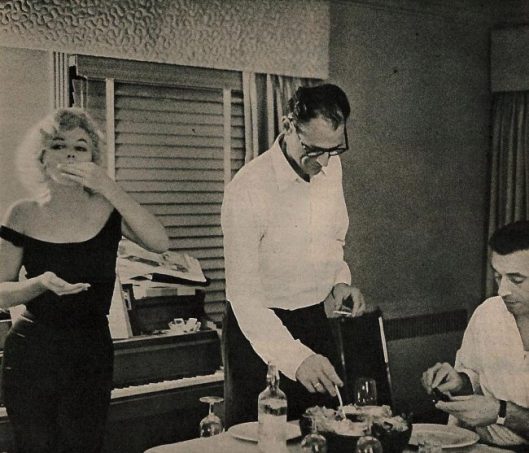
Source photo by Bruce Davidson, 1960
Picture Show, dating from the same period, takes its name from a magazine widely read by British movie fans. Set against a gold, sequinned background, it depicts a variety of influences from high art, low culture and revolutionary politics. The classic, gilt-framed beauty of Goya’s Doňa Isabel de Porcel contrasts with that of French salon hostesses Madame Pompadour and Madame Recamier, 1920s flappers, and a relaxed Marilyn Monroe, captured by Magnum agency photographer Bruce Davidson in 1960.
On a break from filming Let’s Make Love, Marilyn was holding an informal dinner party for herself, husband Arthur Miller, co-star — and soon-to-be lover — Yves Montand, and his actress wife, Simone Signoret (to whom Boty has also been compared.) All four were then living in neighbouring bungalows at the Beverly Hills Hotel. In Davidson’s candid image, Monroe continues eating as she walks away from the table, unconcerned by the strap falling off her little black dress.
Some might dismiss Boty’s early works as juvenilia, a prejudice reinforced by the ‘homemade’ appearance of her collages in particular. But this line of thought disregards how unusual Boty’s work was in her own time. Surely, these criticisms cannot be levelled at My Colouring Book (1963), the largest — and perhaps most accomplished — work in the first room.

Source photo from LIFE, 1958

My Colouring Book by Pauline Boty (1963)
Using lines from the pop song of the same name (recorded by three female vocalists in 1962, and covered many times thereafter), My Colouring Book brings the lyrics to life, with a lonely bedroom topped by two hearts balanced on a rainbow. Each stage of the drama is accorded a separate panel, with a blank face shaded by blue glasses; green beads worn on a date; and a Serge Gainsbourg lookalike in a black, beatnik-style leather jacket, smoking.
There is also another Monroe reference in My Colouring Book which seems to have gone unnoticed by the curators. Richard Avedon’s 1957 portrait of a newlywed Marilyn, hugging playwright Arthur Miller, forms the basis of another panel. Miller is reduced to a white, featureless outline, contrasting with Marilyn’s flesh tones, all over a red backdrop. By 1963, when Pauline finished My Colouring Book, Miller had divorced and remarried, while Monroe was almost a year dead.
The caption, in red transferred letting, reads ‘THESE are the arms that Held Him and Touched Him & lUST Him Somehow/Colour Them empty nOW.’ (Boty has replaced ‘lost’ with ‘lust’.)
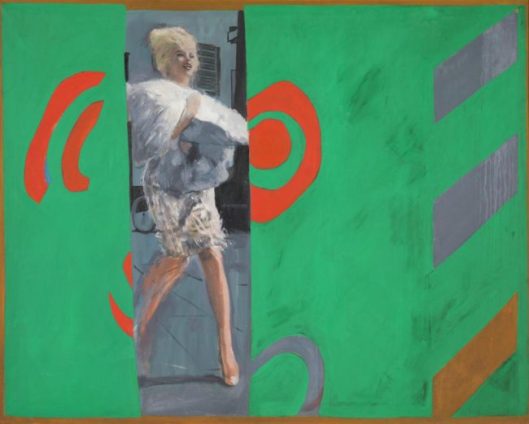
The Only Blonde in the World by Pauline Boty

Pauline Boty with her painting in 1962

At left, source photo of Marilyn in Some Like It Hot (1959); and at right, the painting in LIFE magazine (1963)
The Only Blonde in the World takes its title from a Time magazine tribute to Marilyn Monroe, published after her death in August 1962. Boty’s avocado-green abstract is sliced open by a monochrome image of Monroe in Some Like it Hot (1959), its muted colours suggesting that despite its power, this is ephemeral — Marilyn’s image, not her reality.
The original photograph, published in the American magazine, Life, was repainted by Boty, and shows Monroe filming a scene where she runs across a boardwalk to meet her lover on his yacht. The actress was pregnant at the time, and later miscarried. Some believed the repeated takes of this sequence may have damaged her unborn child, but that is speculative.
Nonetheless, Marilyn — or Sugar Kane, her character — is in motion, accentuated by Boty’s red curves, with slanted blue lines in the corner pointing, perhaps, to an uncertain future.
A second Monroe painting, Colour Her Gone, was acquired by Wolverhampton Art Gallery in 2012. The image of Marilyn is based on a photo taken by George Barris on Santa Monica Beach, just weeks before she died. Despite the contrast between her dark eyebrows, false eyelashes and windswept, bleached blonde hair, her smile is radiant, unaffected.

In November 1962, Barris’s photo adorned the cover of a British style magazine, Town, with the elegiac caption, ‘Marilyn Monroe in Admiration.’ Pauline painted Colour Her Gone soon after. The title is another reference to My Colouring Book, and once again, Marilyn bursts through an abstract as if emerging from the covers of a book. Here, however, the tone is reversed. Draped in red roses, Marilyn provides the colour, encased in funereal grey.

Source photo by Lawrence Schiller for Pauline Boty’s Epitaph to Something’s Gotta Give (1962)
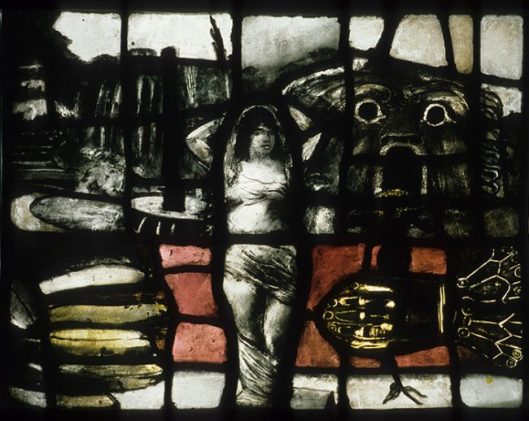
The Siren by Pauline Boty, ca. 1959-60
A third work in this series is entitled Epitaph to Something’s Gotta Give, denoting Monroe’s final, unfinished film. It was inspired by a photo by Lawrence Schiller, taken during shooting of Marilyn’s nude pool scene. Had the film been released, it might have been one of her defining moments.
The background is red, with circular shapes evoking reels of film, while Monroe’s face bobs out of water. Her mouth is open, suggesting a healthy, unfettered appetite. The Siren, a recurring figure from Boty’s early collages and stained glass works, stands in the foreground, cocooned in a womb-like green ring and linking Monroe to an older artistic tradition, as another kind of goddess. Although Marilyn’s life was nearly over, this painting points to rebirth.
Photographs taken in Boty’s home show her posing with other, lost paintings of Monroe. In one, based on Richard Avedon’s portrait of Marilyn as Sugar Kane, Pauline mimics her pose, biting coyly on a string of pearls.
Many of the magazine images copied in Boty’s paintings can be seen in a giant montage on her bedroom wall, glimpsed when she posed alongside her work.
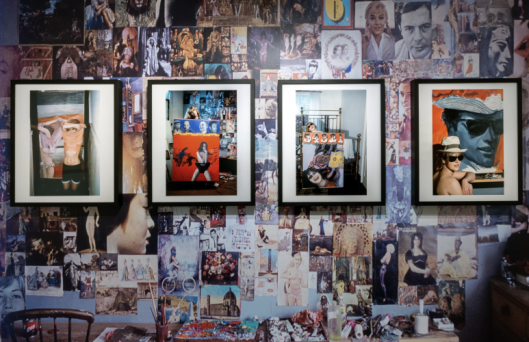
In this installation at Gazelli Art House, we see framed images of Pauline posing with some of her paintings mounted onto a giant reproduction of the wall montage from her London home, featuring two photos of Marilyn by Richard Avedon (cut out from copies of Life) and another by Eve Arnold (from the Sunday Times magazine.)

After Boty’s death in 1966, her friend Christopher Logue eulogised her in a ‘poster poem,’ Gone Ladies – featuring images of Marilyn during her only trip to England in 1956, attending a royal film performance at the Empire Theatre in Leicester Square, where she was introduced to Queen Elizabeth II.
A feature-length documentary, BOTY: The Life & Times of a Forgotten Artist, is due for release this year. And finally, for further information on this fascinating woman I recommend you read Marc Kristal’s recently published biography, Pauline Boty: British Pop Art’s Sole Sister.

 Tara Hanks
You must be logged in to post a comment.